Why 2026 Will Be the Year CMOs Take Full Control of Revenue
- Roger M.

- Nov 14, 2025
- 6 min read
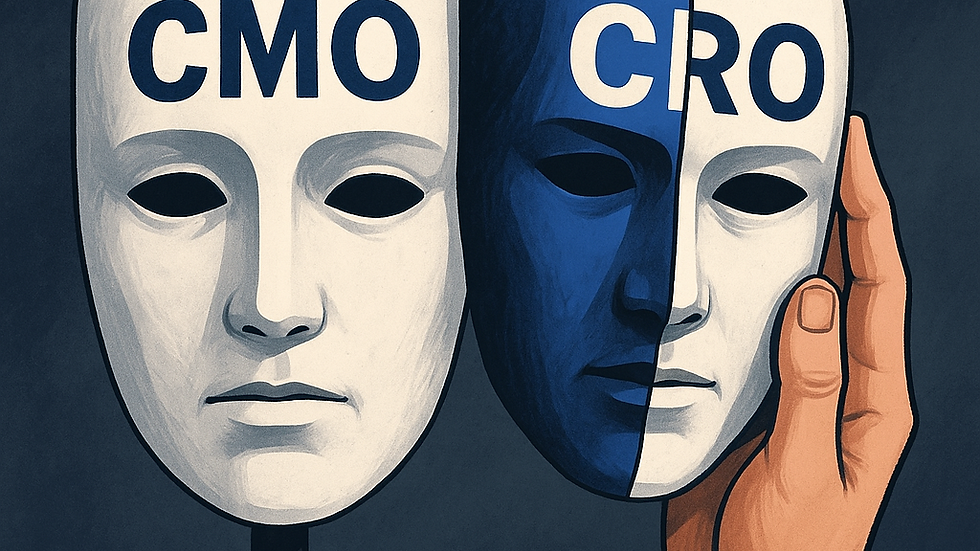
The role of Chief Marketing Officer has turned upside down in just a couple of years. If you talk to any CMO today, they’ll tell you their job barely resembles what it was even five years ago. Why? It’s a wild mix of new AI tools, unpredictable economies, and customers who expect more than ever. By 2026, CMOs won’t just be running ads—they’ll be responsible for the money coming in the door. Marketing isn’t just a creative job anymore; it’s about understanding people, making smart use of data, and figuring out what really works. That’s why more and more CMOs are stepping up as the people who know how to help a business grow for the long haul.
To show why 2026 is the tipping point for CMO revenue accountability, we analyze nine forces driving the shift and how each one expands CMO ownership of growth.
1. The Rise of Agentic AI Elevates CMOs to Strategic Revenue Leadership
Agentic AI is redefining how work is done. Traditional knowledge tasks, from segmentation to optimization to content operations, are now automated through AI agents capable of reasoning and orchestrating multistep workflows. This automation shifts power away from manual execution and toward strategic oversight. As McKinsey notes, the limiting factor is no longer technology, but human ability to manage and direct agents.
This shift means CMOs are in charge of building the systems that help a business grow. With customer insights and feedback, they are best positioned to use AI to boost sales. Now, CMOs must experiment with new tech and create adaptable teams.
2. Consumer Behavior in 2026 Demands More Trust, More Value, and More Proof
Global data from NIQ shows consumers in 2026 are confident yet cautious, intentional with their spending, and protective of value. Cost-of-living pressures shape purchasing decisions, while brand trust has become nearly universal in importance. Consumers are reducing discretionary spending and prioritizing essential categories such as healthcare, insurance, education, and groceries.
It’s tough to earn customer loyalty these days. With more choices than ever, one bad experience can send customers elsewhere. CMOs must show why their brand matters, simplify offerings, and build trust. Growth is about relevance and ensuring customers want to return. Marketing is key to ensuring the company keeps its promises to customers.
3. Retail Media, Personalization, and Seamless Commerce Expand CMO Revenue Influence
The rapid rise of retail media networks (RMNs), personalized experiences, and commerce ecosystems gives CMOs unprecedented access to deterministic, real-time customer data. These networks provide closed-loop attribution, shopper intent, and measurable sales outcomes. Instead of indirect metrics, CMOs now control direct purchase pathways and commercial partnerships.
All this new data and technology put marketing right in the middle of the action when it comes to making money. CMOs can use insights from how people shop, what they value, and where they spend time online to decide what products to launch, how much to charge, and what kind of experience to offer. Marketing isn’t just about the first impression anymore—it’s involved at every step, from first click to loyal customer.
4. Forrester’s 2026 Budget Data Shows Power Shifting Toward Marketing
Forrester’s 2026 Budget Planning Guide reveals a striking reality: CMOs are receiving more investment, more autonomy, and more expectations than any other growth function. Eighty-three percent of B2B leaders anticipate higher marketing budgets, with the fastest growth in technology spending. Marketing is now responsible for revenue process transformation, lifecycle monetization, and advanced audience architectures.
With larger budgets and greater responsibility, CMOs are now expected to lead the charge in generating revenue. Companies want marketing teams that can move fast, make smart financial decisions, and come up with creative ways to grow. It’s no surprise that CMOs are turning into the go-to people for figuring out how to make a business thrive.
5. Traditional Sales Pipelines Are Breaking, Further Elevating Marketing’s Role
B2B and B2C buying behavior has fundamentally shifted. Buyers avoid early sales conversations, rely on communities and peer networks, and use AI assistants to research, evaluate, and shortlist vendors. Sales is no longer the owner of the early or mid-funnel. Marketing controls discovery, intent generation, education, and validation.
Now, sales teams might close the deal, but marketing is what gets the ball rolling. Long before anyone talks to a salesperson, marketing is out there shaping opinions, building trust, and helping people figure out what they need. These days, getting people interested and keeping them on board is mostly a marketing job—and the numbers back it up.
6. The Agentic Organization Model Favors Marketing’s Operating Style
The emerging organizational structure described by McKinsey—flatter teams, rapid experimentation, cross-functional squads, and outcome-driven work—is closest to how marketing has operated for a decade. Marketing is agile by design, used to rapid iteration, testing, learning, and adaptation.
As companies adapt, CMOs guide teams through uncertainty, leveraging marketing’s agility. Marketers excel at rapid response, digital campaigns, and uniting diverse skills—traits that align well with today’s business structures.
7. Five Structural Shifts Push CMOs Toward Full Revenue Ownership
The convergence of technology, consumer shifts, budget consolidation, and organizational restructuring creates five irreversible changes:
1. AI automates execution, elevating strategy. CMOs define the strategic controls that guide AI-driven revenue systems.
2. Budget power concentrates under the CMO. Demand gen, brand, lifecycle marketing, martech, and RMN budgets are now under the marketing budget.
3. Consumers reward trust and consistency. Marketing manages the emotional and experiential layers that drive loyalty and repeat revenue.
4. Revenue systems become marketing assets. Attribution, forecasting, personalization, identity resolution, and lifecycle orchestration are marketing capabilities.
5. Boards want a single growth leader. Marketing possesses the broadest, most integrated view of revenue drivers.
Collectively, these forces set the CMO as the architect, executor, and accountable owner of enterprise revenue.
8. The New CMO Playbook for Total Revenue Control
CMOs who want to lead in 2026 must operate across six domains:
AI-Led Revenue Architecture Designing agentic workflows, automated intelligence systems, and governed AI pipelines.
Growth Economics Mastering lifetime value, marginal CAC, retention models, and pricing dynamics.
Full-Funnel Ownership Controlling awareness, demand, lifecycle, loyalty, and expansion strategies.
Growth Operations (RevOps) Unifying sales, marketing, and product signals into one revenue operating system.
Customer Experience Leadership Orchestrating personalized, trust-driven, omnichannel experiences.
Organizational Leadership Upskilling teams for AI, running agile squads, and building adaptive workflows.
These are the skills and tools CMOs will need to really own the revenue game in 2026.
9. Why 2026 Is the Breakout Year for CMO Revenue Ownership
AI, consumer trends, budgeting, and organizational shifts all converge on a single outcome: marketing becomes the enterprise’s primary revenue engine in 2026.
Seven structural forces make this inevitable:
AI removes operational friction and accelerates everything.
Budgets and accountability are shifting toward marketing.
Consumers demand value and trust, not noise.
Buying paths are fragmented and nonlinear, favoring marketing leadership.
Data, personalization, and identity graphs place marketing at the center.
Agentic organizations mirror marketing’s natural operating model.
Boards want predictable, scalable, customer-centric revenue.
Everything points in one direction: marketing becomes the primary source of enterprise growth.
Conclusion: The CMO Becomes the Chief Revenue Owner
The changes in 2026 are a game-changer for CMOs. They are moving from overseeing brand to shaping how the business generates revenue—leveraging customer insight, data, and AI to ensure performance. With automation and complex customer journeys, the CMO connects the dots to keep revenue flowing.
Sales will always matter, but it’s marketing that sets the rules for how sales teams work. Finance will still keep an eye on the bottom line, but marketing decides how the company goes after revenue. And while tech teams keep everything running, it’s marketing that’s leading the charge in growing the business.
In 2026, CMOs will be directly responsible for driving and managing revenue, overseeing both strategy and execution across the business.
And the organizations that embrace this shift earliest will build the most resilient, adaptive, and customer-centric growth engines of the next decade.
References:
McKinsey & Company. (2025). The Big Rethink: An agenda for thriving in the agentic age. McKinsey Global Institute.
McKinsey & Company. (2025). The changing role of the CMO—and what it means for growth. The McKinsey Podcast / McKinsey Live Webinar.
NielsenIQ. (2025). Consumer outlook: Guide to 2026. NIQ Global Consumer Research.
Forrester Research, Inc. (2025). Budget planning guide 2026: B2B marketing executives. Navigate persistent volatility with strategic focus to drive growth. Forrester Planning Guide Report.
Flowcode. (2025). 2026 CMO growth playbook: The CMO situation room. Flowcode Marketing Intelligence Report. American Marketing Association.
Gartner. (2025). Predicts 2025: Rebalance demand gen investments for impact. Gartner Research.
Gartner. (2025). 2025 CMO spend survey: Marketing budgets flatline at 7.7% of company revenue. Gartner Benchmark Survey and Press Release.


Comments