From Silos to Synergy: How RevOps Eliminates Revenue Bottlenecks
- Roger M.

- Aug 9, 2025
- 5 min read
Updated: Mar 22
Introduction: The Cost of Silos in the Revenue Engine
In the old growth playbook, sales hunted, marketing generated leads, and customer success put out fires. Each function had its own metrics, tech stack, and operating cadence. The thinking was linear—marketing handed off to sales, sales closed deals, and customer success maintained relationships.
That model is obsolete.
Today’s revenue landscape is non-linear and perpetual. It’s no longer a funnel—it’s a flywheel of acquiring, engaging, and delighting customers, where retention and expansion are just as important as acquisition. Every interaction matters, and every touchpoint influences lifetime value. But there’s a problem: friction.
This friction—rooted in siloed teams, disconnected data, and misaligned goals—slows down revenue velocity, increases acquisition costs, and erodes customer loyalty.

According to ProfitWell and HubSpot's State of RevOps Report, companies that give their teams access to unified revenue data grow significantly faster than those that don’t.
Enter Revenue Operations (RevOps)—a strategic, cross-functional framework that aligns marketing, sales, customer success, and other revenue-impacting functions to maximize revenue outcomes, optimize the customer journey, and remove bottlenecks.
As both a CMO and CRO, I’ve seen RevOps transform organizations from fragmented, reactive structures into synchronized growth machines. In this article, we’ll explore:
Why silos persist and how they create revenue bottlenecks
The RevOps framework for breaking them down
Key pillars—people, process, technology—that make RevOps work
Data-backed benefits from top studies
A Formula 1 pit crew analogy to illustrate RevOps in action
Implementation roadmaps and maturity models
Part 1: The Hidden Bottlenecks Inside Revenue Silos
1. Disconnected Data and Blind Spots
Siloed operations mean fragmented data. Marketing may have campaign performance data, sales has pipeline numbers, and customer success tracks churn—but none of it talks to each other. Without unified revenue metrics, decision-making becomes guesswork.
Gartner highlights that marketing, sales, and customer data are often inconsistent or outdated, making them unusable for coordinated strategy. In this environment:
Marketers might optimize for channels that drive sign-ups but low LTV.
Sales leaders might celebrate top performers whose deals churn quickly.
Customer success might miss upsell opportunities due to lack of account context.
2. Conflicting Goals That Erode Growth
When teams set goals in isolation, they often work at cross purposes. ProfitWell data shows that organizations without unified goal-setting grow slower than those with RevOps-aligned objectives.
Example: Marketing focuses on volume leads, while sales prioritizes high-ticket deals, and customer success is tasked with improving net retention. Without a shared framework, each function optimizes for its own KPIs—even if that means sacrificing overall revenue efficiency.
3. Technology Sprawl and Process Inefficiency
Over the past decade, the martech and salestech landscapes have exploded, surpassing 8,000+ tools. Each department buys and manages its own stack, leading to:
Redundant software costs
Inconsistent workflows
Data silos that block automation and AI use
This complexity slows execution and creates onboarding challenges for new hires.
4. The Discount-Driven Churn Trap
Siloed sales teams often rely on end-of-quarter discount pushes to hit quota. But heavy discounting correlates with high churn rates. Without LTV visibility, sales reps may unknowingly close “bad fit” customers that marketing and customer success have to deal with later.
Part 2: RevOps as the Antidote
RevOps is not just a rebrand of sales ops or marketing ops—it’s an integrative operating system for revenue growth. It consolidates the operational backbone of marketing, sales, customer success, and sometimes finance and product into a single, coordinated function.
The Pit Crew Analogy

Think of your revenue organization as a Formula 1 race team:
Driver (Sales) – gets the glory for winning deals, but depends on the rest of the team to succeed.
Engineers (Marketing) – design the car (your GTM strategy), optimize aerodynamics (your positioning), and feed performance insights.
Strategists (Customer Success) – chart the course, adapt to changing track conditions, and ensure you finish the race (customer lifetime value).
Pit Crew (RevOps) – tunes the engine in real-time, monitors telemetry (data), ensures seamless handoffs, and removes friction so everyone performs at peak speed.
Without the pit crew, the car might still run—but it will never win consistently.
Core Functions of RevOps

According to Gartner and Accenture, high-performing RevOps teams excel in six areas:
Strategy & Planning – Translating GTM strategy into operational execution
Process & Workflow – Standardizing and integrating workflows across the customer lifecycle
Enablement – Equipping teams with training, content, and tools to perform
Analytics & Measurement – Providing a unified view of revenue performance
Data Management – Centralizing and cleaning customer and revenue data
Technology Platform – Building a cohesive, integrated tech stack
Part 3: Data-Backed Benefits of RevOps
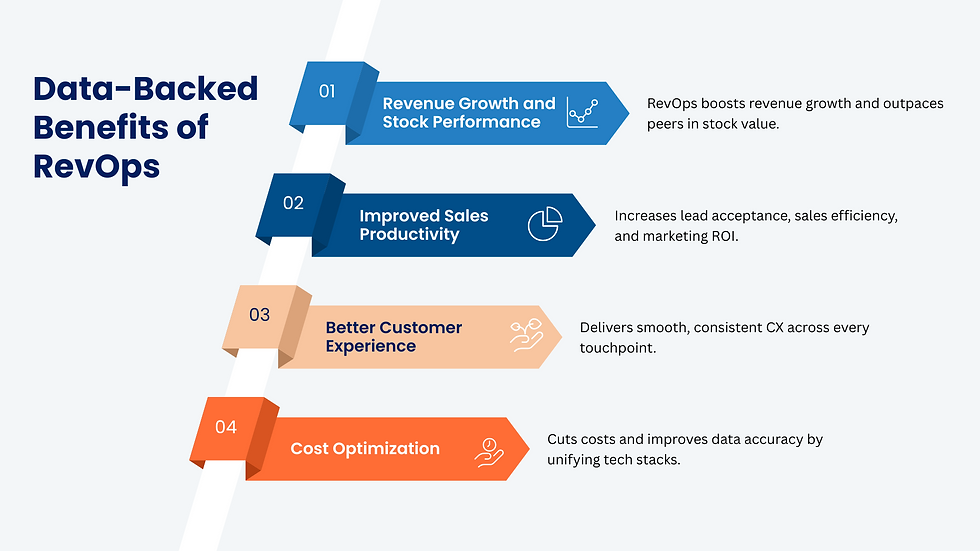
1. Revenue Growth and Stock Performance
SiriusDecisions found that S&P 500 companies adopting RevOps grew revenue at 19.5% vs. 7.3% for non-adopters.
Companies with RevOps alignment also outperformed peers in stock value growth over the same period.
2. Improved Sales Productivity
B2B SaaS companies implementing RevOps report higher lead acceptance rates, improved sales productivity, and better ROI from digital marketing.
3. Better Customer Experience
RevOps enables consistent, end-to-end CX by ensuring all departments work from the same playbook and data set. This reduces friction in onboarding, support, and expansion conversations.
4. Cost Optimization
By unifying tech stacks and eliminating redundant tools, RevOps reduces operating costs while increasing data accuracy—a critical factor for AI readiness.
Part 4: Building a High-Impact RevOps Function
The People-Process-Technology (PPT) Framework
Accenture’s global RevOps maturity study outlines three pillars:
People – Alignment, skills, and leadership
Cross-functional collaboration beyond just sales and marketing (e.g., with finance and product)
Skills in analytics, AI, and change management
Executive sponsorship to drive adoption
Process – Standardization and customer-centric design
End-to-end visibility into revenue processes
Unified metrics and KPIs tied to strategic goals
Feedback loops to adapt based on customer insights
Technology – Integrated stack and unified data
Centralized data warehouse or CRM
Automated workflows spanning marketing, sales, and CS
AI-driven insights for forecasting and personalization
Maturity Model
RevOps maturity ranges from ad hoc to systemized:
Ad Hoc – Siloed functions, inconsistent processes, fragmented data
Emerging – Some collaboration, basic shared metrics, partial data integration
Scaling – Standardized workflows, centralized data, executive oversight
Systemized – Fully integrated operations, AI-driven decision-making, measurable impact on revenue efficiency
Only 6% of software companies have reached the scaling/systemized stage—a massive opportunity for competitive advantage.
Part 5: Implementation Roadmap
Phase 1 – Discovery & Alignment (0–90 Days)
Map current revenue workflows and tech stack
Identify data silos and bottlenecks
Secure executive sponsorship and set shared goals
Phase 2 – Standardization & Integration (90–180 Days)
Create unified KPIs across marketing, sales, and CS
Integrate tech stack (CRM, marketing automation, CS tools)
Clean and centralize customer data
Phase 3 – Optimization & Enablement (180–365 Days)
Automate cross-functional workflows
Build dashboards for real-time revenue insights
Train teams on RevOps processes and tools
Phase 4 – Scale & Innovate (Year 2+)
Layer AI for predictive forecasting and personalization
Continuously refine processes based on data
Expand RevOps alignment to finance, product, and partnerships
Part 6: The Future—RevOps + AI
Generative AI will supercharge RevOps by:
Automating data cleansing and enrichment
Generating real-time insights from unified datasets
Predicting churn and identifying upsell opportunities
However, AI’s effectiveness depends on data unification—a core RevOps mandate.
Conclusion: From Chaos to Compounding Growth
Silos aren’t just inconvenient—they’re expensive. They slow revenue velocity, inflate acquisition costs, and weaken customer relationships. RevOps replaces this chaos with coordinated execution, unified data, and shared accountability.
For organizations serious about sustainable, scalable growth, RevOps isn’t a trend—it’s the new operating system for revenue. And like a Formula 1 pit crew, when it works well, it’s invisible in the moment but unmistakable in the results: faster, smoother, and more consistent wins.
Sources: ProfitWell & HubSpot, The State of RevOps Report, Gartner, Defining Revenue Operations, Mottola, O., The Revenue Operations (RevOps) Framework, Ahmad, T.H., & Gaston-Breton, C., Revenue Operations in B2B Technology, Accenture, Simplify and Scale with Revenue Ops.


Comments